Qualcomm CEO: AI Agents Are the New Apps — What It Means for Developers
Qualcomm CEO Cristiano Amon says AI agents will become the primary interface and the 'new app.' Here's the full breakdown — the quotes, the 40+ device designs, the smart-glasses bet, and what an agent-first world means for the way developers build software.
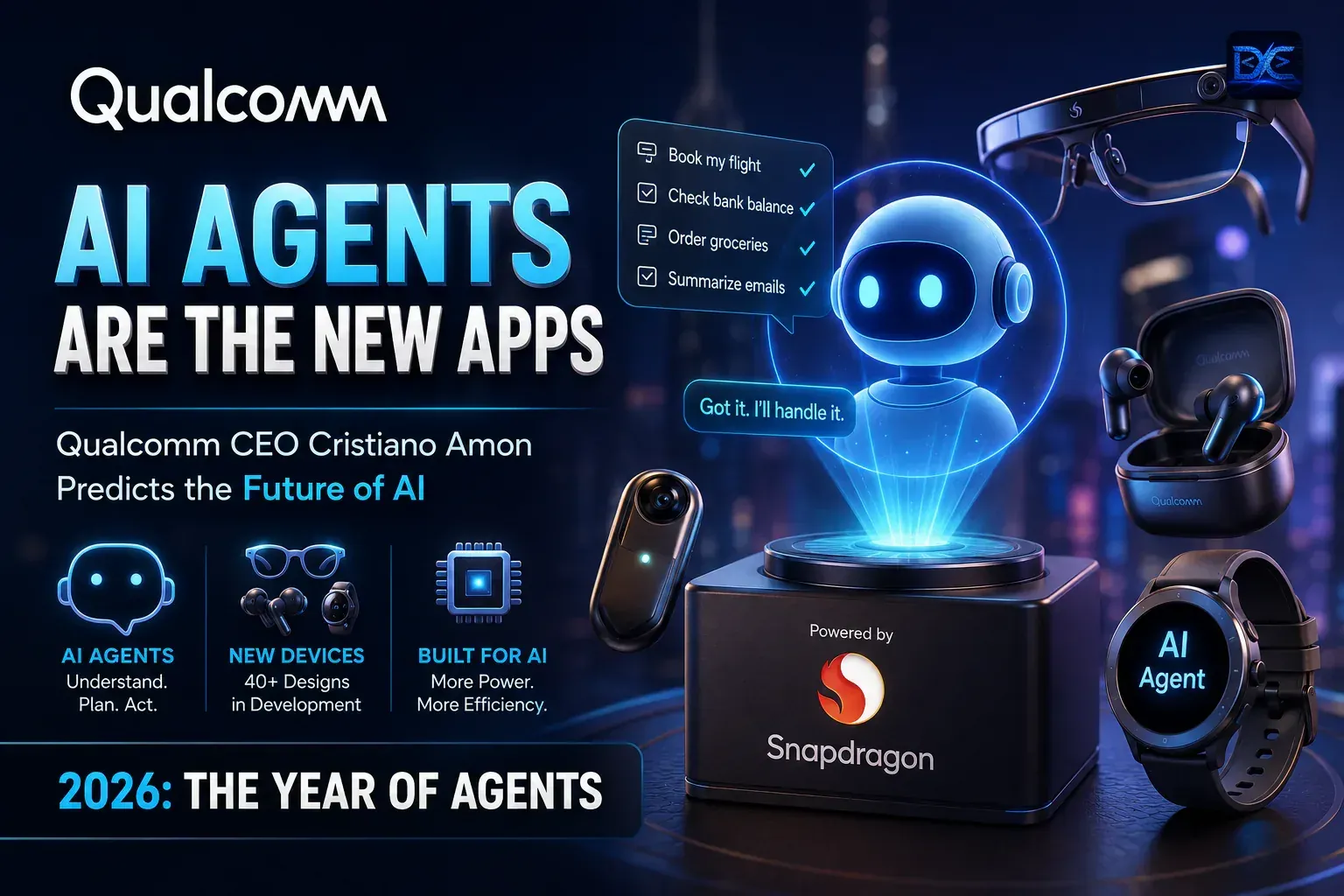
For fifteen years the smartphone has been the center of gravity of digital life. You tap an icon, an app opens, you do the work yourself — navigate menus, fill forms, copy details between screens. Qualcomm’s CEO Cristiano Amon thinks that era is ending. In a June 2026 interview on CNBC’s The Tech Download podcast, he laid out a blunt thesis: AI agents are becoming the new app, and the device in your pocket is about to stop being the thing everything revolves around.
This isn’t a throwaway keynote line. Amon backed it with hardware: Qualcomm is already working on 40+ designs for a new wave of agent-first devices. Here’s what he actually said, why a chip company is the one saying it, and — the part that matters for this site — what it changes about how you build software.
The core claim: apps don’t die, they get demoted
Amon was careful not to declare apps dead. His framing is subtler and more interesting:
“Apps are not dead … but apps are going to change. Those agents are going to be the new app.”
The argument is about where the user spends their attention. Today you are the integration layer: you open your bank app, read a balance, switch to a travel app, book a flight, switch to email to find a confirmation. An agent collapses all of that into one intent — “book me the cheapest flight home Friday and pay from my main account” — and does the app-hopping for you.
“The phone is around the agent. The new classes of devices … are going to be around the agent as well. And the agent will be the one that will understand human intentions and will do things for you, so there is a shift in what the center of gravity is.”
That phrase — center of gravity — is the whole thesis. The agent becomes the hub; phones, watches, glasses, and earbuds become satellites that feed it context and surface its responses.
Agents vs. the assistants you already know
This is explicitly not Siri-with-a-new-coat. The distinction Amon draws is the same one separating a chatbot from a coding agent: planning and execution across boundaries.
| Voice assistant (Siri / Gemini, 2016–2024) | AI agent (2026+) | |
|---|---|---|
| What you give it | A single command | A goal or intention |
| Scope | One app, one step | Many apps/services, many steps |
| Behavior | Reactive — waits to be asked | Proactive — acts with context |
| Awareness | The current screen | Your history, location, calendar, the web |
| Example | ”Set a 10-minute timer" | "Find a dog-friendly hotel near the venue and book it” |
The agent understands intent, makes a plan, executes it across apps and the open internet, and reports back — conversationally, by voice or chat. That loop — intend → plan → act → observe → continue — is exactly the pattern reshaping developer tooling, now pointed at consumers.
Why a chip company is making this call
It’s easy to dismiss platform predictions as marketing. But Qualcomm has a specific, structural reason to bet on agents: an agent that “sees the world” needs always-on, low-power silicon in small devices. That’s Qualcomm’s core business.
- 40+ device designs in flight. Amon: “Right now, we have over 40 designs of those devices, and I’m telling you, the types of form factors are very, very broad.” Think jewelry, camera-equipped earbuds, wearable pins, watches.
- Smart glasses are the headline bet. He sees today’s “multiple tens of millions” of annual shipments scaling to “hundreds of millions” within a couple of years — approaching smartphone scale.
- The current chips aren’t ready. Qualcomm is reworking its entire roadmap for processors that are more capable yet far more energy-efficient, so an agent can run continuously on a device the size of a pin without melting or dying by noon.
The strategic logic: if the agent is the new center of gravity, whoever supplies the always-on, context-sensing endpoints owns critical real estate. That’s why this came from a silicon CEO and not a software one.
The land-grab for “endpoints”
Amon’s comments land in the middle of an industry scramble that explains a lot of 2025–2026’s biggest moves. AI companies want to own the endpoint — the device where the agent meets the physical world — because endpoints generate the new data streams that train the next models and personalize the experience.
That’s the subtext behind deals like OpenAI’s acquisition of Jony Ive’s hardware startup: control the hardware, control the context, control the data flywheel. Amon has repeatedly framed 2026 as the “Year of Agents” (at Computex and elsewhere), and the endpoint race is the physical expression of that thesis.
What this actually means for developers
Here’s the part the headlines skip. If agents become the primary interface, the value of your software doesn’t disappear — it moves down the stack. Your polished UI stops being the product; your capabilities become the product.
1. Your app becomes an API for agents. The “user” calling your service may increasingly be an agent, not a human with a mouse. The winners will expose clean, well-documented, machine-consumable interfaces. If a human can do something in your app but an agent can’t reach it programmatically, that capability is effectively invisible in an agent-first world.
2. MCP-style integration becomes table stakes. Standards like the Model Context Protocol let any agent plug into any tool through one interface. Shipping an MCP server (or equivalent) for your product becomes as expected as shipping a mobile app was a decade ago.
3. Design for intentions, not screens. Agents consume structured outcomes, not pixels. Return clean data, explicit states, and unambiguous errors. “Plausible but wrong” is an agent’s classic failure mode — make your responses hard to misinterpret.
4. On-device and low-latency matter again. Amon’s whole bet is energy-efficient silicon in small, always-on devices. That revives interest in on-device inference, edge compute, and lean models that run where the data is — a different optimization target than cloud-first apps.
5. Trust, permissions, and auth get harder. An agent acting on a user’s behalf — “retrieve my banking details,” “pay from my account” — raises the stakes on authorization, scoping, and auditability. Agent delegation, consent, and revocation are about to become first-class product problems, not afterthoughts.
Takeaway: The opportunity isn’t “rebuild your app as an agent.” It’s make your service the best possible tool for an agent to use — discoverable, structured, permissioned, and fast.
The honest caveats
A few things worth holding in tension with the vision:
- Amon is talking his book. Agent-first hardware is Qualcomm’s growth story, so the timeline is the optimistic one. “Year of Agents” has been declared before.
- Apps won’t vanish on schedule. Habits, app stores, and billions of installed devices are enormous inertia. Even Amon says apps “are not dead.”
- Form factor is unproven at scale. Smart glasses and AI pins have a mixed track record. “Hundreds of millions” is a forecast, not a shipment number.
The direction of travel is credible even if the dates slip. Treat it as a trajectory to prepare for, not a deadline to panic about.
Bottom line
Amon’s message to developers is really a message about leverage. The interface is moving from the screen you design to the agent that acts on your user’s behalf. The teams that win the next cycle won’t be the ones with the prettiest UI — they’ll be the ones whose services an agent can find, understand, trust, and operate.
Start now: expose clean APIs, ship structured outputs, think about agent auth, and experiment with on-device and MCP-style integration. Whether the “Year of Agents” arrives in 2026 or 2028, the codebase you make agent-ready today is the one still relevant when the center of gravity finally shifts.
Source: Cristiano Amon, interviewed on CNBC’s “The Tech Download” podcast (June 16, 2026); additional coverage via Android Headlines and Fortune.
Related articles

Why AI Coding Agents Will Change Software Development in 2026
What AI coding agents are, how they differ from autocomplete assistants, the tools that matter in 2026, real use cases, the productivity math, security risks, and how to fold agents into your daily workflow without regrets.

SpaceX Acquires Cursor for $60B: What It Means for AI Coding in 2026
SpaceX has agreed to buy Anysphere — the maker of AI code editor Cursor — for $60 billion in an all-stock deal. Here's the full breakdown: the timeline, the strategy behind pairing Cursor with SpaceX's Colossus supercompute, what it means for developers, and the honest caveats on a fast-moving story.
MCP Servers Explained: The Future of AI Tool Integration
What the Model Context Protocol (MCP) is, how MCP servers work, why it beats bespoke API glue, a hands-on server example, the growing ecosystem, security considerations, and where it's all heading.
Have a project or an idea?
We don't just write about software — we build it. Tell us what you're working on and we'll get back within 1–2 business days.