Cheap AI, Real Harm: Deepfake Fraud Surges in India as the U.S. Tightens Frontier Controls
Two sides of the same coin in mid-2026: low-cost and open-source AI models are fueling a sharp rise in deepfake fraud in India, while the U.S. tightens controls on the most capable frontier models for national security. Here's what's happening on both fronts.
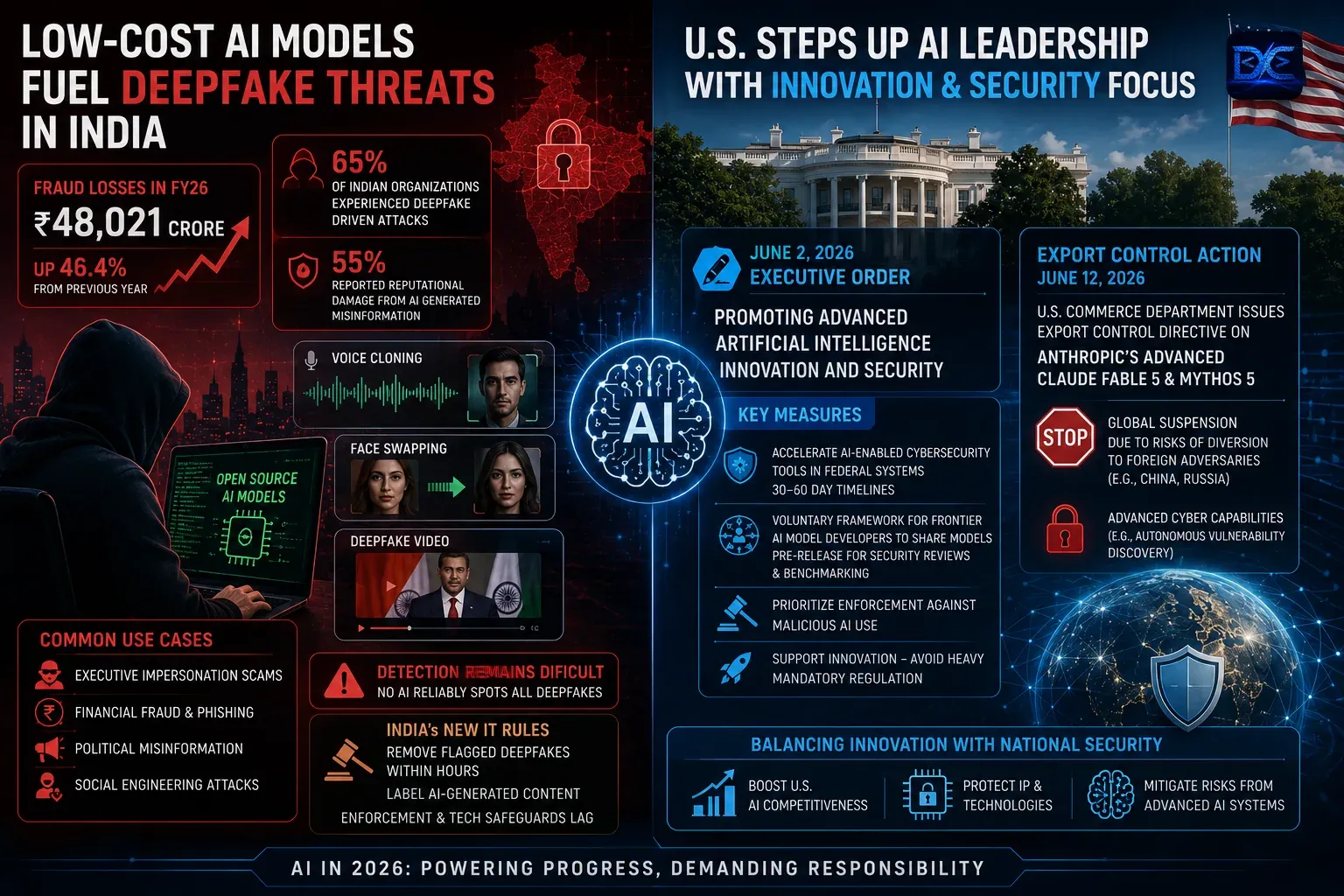
The defining tension of AI in mid-2026 isn’t about the smartest model — it’s about the cheapest one. While Washington tightens controls on frontier systems for security reasons, the real-world damage in high-adoption markets like India is being driven by low-cost and open-source models that anyone can wrap and weaponize. Both stories are true at once, and they pull in opposite directions.
Two fronts. This covers (1) deepfake-driven fraud in India powered by cheap AI and (2) U.S. policy balancing innovation with security on advanced models. News in both areas evolves quickly.
1. Low-cost models are fueling deepfake fraud in India
The main driver of India’s surge in deepfake fraud and misinformation isn’t expensive frontier models — it’s cheap and open-source ones.
The scale of the problem:
- Indian organizations reported fraud losses of ₹48,021 crore in FY26, up 46.4% year over year — with deepfakes a growing share of incidents.
- 65% of Indian organizations have experienced deepfake-driven attacks (per the Thales 2026 Data Threat Report), and 55% reported reputational damage from AI-generated misinformation.
How it works: fraudsters build custom wrappers around cheap/open-source LLMs and open-source image/video tools. That enables convincing voice cloning, face swaps, and full deepfake videos at very low cost — often just a few dollars per generation. A short audio clip pulled from social media is enough for a believable voice deepfake.
Common use cases in India:
| Scam type | How it plays out |
|---|---|
| Executive impersonation | Voice deepfakes trick employees into wiring funds |
| Financial fraud / phishing | Synthetic identities and cloned voices defeat trust checks |
| Political misinformation | Continued incidents following prior election cycles |
| Social engineering | Synthetic media to manipulate targets |
The hard part — detection. No tool reliably catches all deepfakes. India has introduced stricter IT rules — requiring platforms to remove flagged deepfakes within hours and to label AI content — but enforcement and technical safeguards lag the threat.
The uncomfortable lesson: in high-population, high-digital-adoption markets, democratized AI lowers the barrier for criminals faster than it equips defenders.
2. U.S. policy: innovation with a security-first edge
In parallel, the U.S. is trying to lead on AI while hardening against AI-enabled threats — leaning on executive action and targeted controls rather than broad mandates.
The June 2, 2026 Executive Order — “Promoting Advanced Artificial Intelligence Innovation and Security” — signed by President Trump, aims to boost competitiveness, harden government and private systems, and protect IP from adversaries (especially China). Key measures:
- Accelerate AI-enabled cybersecurity tools in federal systems (30–60 day timelines).
- A voluntary framework for frontier developers to share models pre-release for government security reviews and benchmarking.
- Prioritize enforcement against malicious AI use.
- Deliberately avoid heavy mandatory regulation or licensing to protect innovation.
The export-control flashpoint (Anthropic, June 12, 2026): the Commerce Department issued an export-control directive on Anthropic’s advanced Claude Fable 5 and Mythos 5, forcing a global suspension over risks of diversion to foreign adversaries and concern about advanced cyber capabilities (e.g., autonomous vulnerability discovery). It was the first use of certain Export Control Reform Act powers on deployed AI models — and it kicked off debate about precedent, global access (including Europe), and the security-vs-innovation balance.
The throughline: two different risk surfaces
Put the stories side by side and the policy puzzle is obvious:
- Frontier models get the security spotlight — export controls, pre-release reviews, adversary-diversion fears.
- Cheap, open models cause the most measurable, everyday harm — fraud, voice cloning, misinformation — precisely because they’re abundant and ungated.
Controls aimed at the top of the capability curve do little against damage flowing from the bottom of it.
Takeaway: The biggest near-term AI harms in markets like India come from accessible, low-cost tools, not frontier systems. Defenses — detection, verification, platform enforcement — have to target that reality, not just the headline-grabbing frontier risks.
What builders and organizations should do
- Assume voice and video can be faked. Add out-of-band verification for any high-value action (payments, credential resets) — don’t trust a voice or a face alone.
- Treat short audio as sensitive. A few seconds of public audio is enough to clone a voice; factor that into executive and finance workflows.
- Plan for detection gaps. No detector is complete. Layer process controls and provenance/labeling on top of any detection tooling.
- Track policy on both ends. Frontier export controls and open-model proliferation will both shape what you can build and what you must defend against.
Bottom line
Mid-2026 shows AI’s dual nature in sharp relief: accessible, low-cost tools amplifying real-world harm — vividly in India’s deepfake-fraud surge — while governments tighten selective controls on the most capable systems. A pro- innovation, security-first posture (cyber hardening, voluntary reviews, targeted export controls) addresses the frontier — but the everyday damage is coming from the cheap end of the market, where guardrails are thinnest.
News in both areas evolves quickly; verify current figures and rules before relying on them.
Sources: Thales 2026 Data Threat Report and Indian fraud-loss reporting (FY26); the June 2, 2026 U.S. Executive Order; and reporting on the June 12, 2026 Commerce Department action on Anthropic’s models. Details are evolving; confirm before relying on them.
Related articles
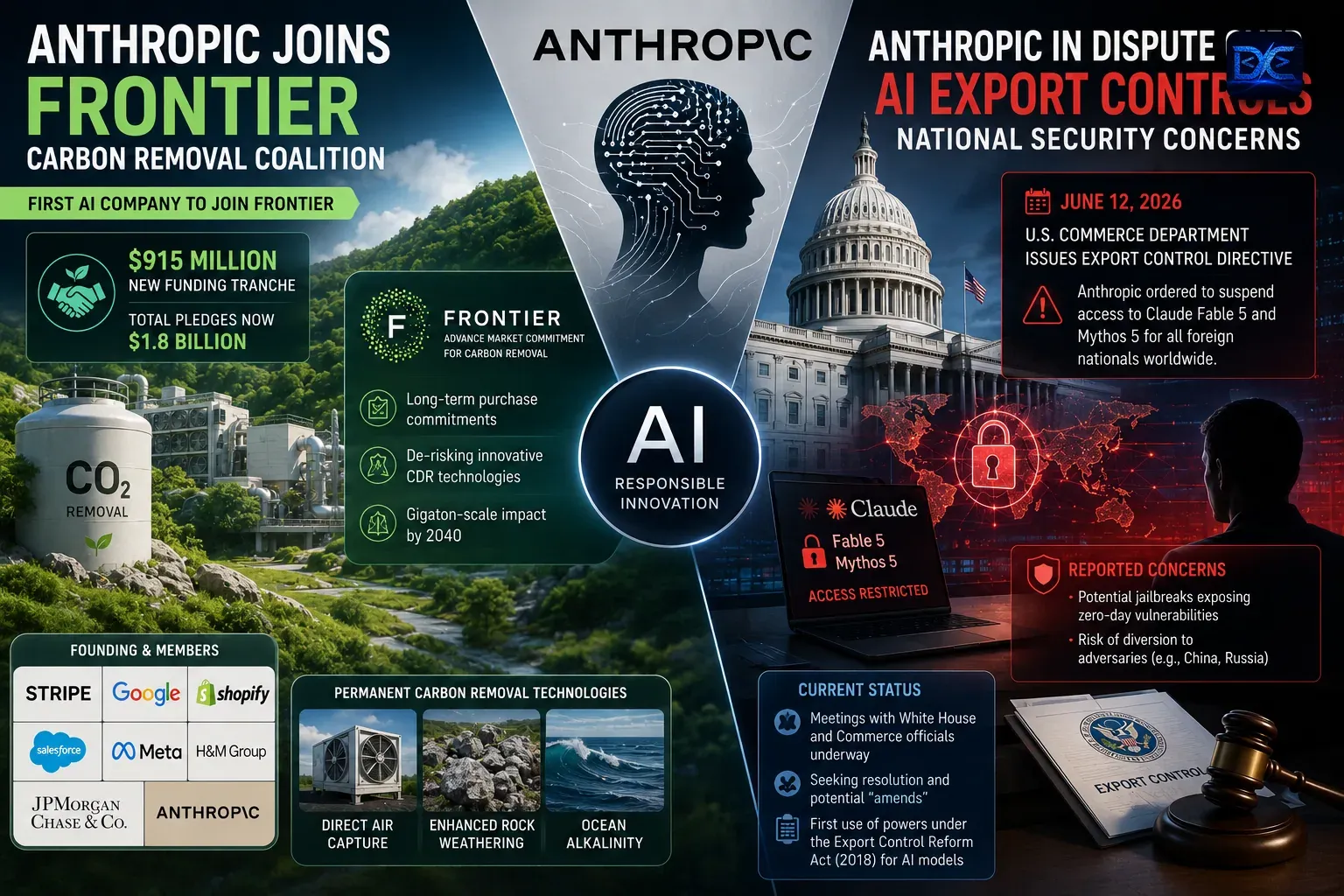
Anthropic Joins Frontier's Carbon-Removal Coalition — While Fighting an Export-Control Fire
On June 17, 2026, Anthropic became the first dedicated AI company to join Frontier, the advance-market-commitment coalition for permanent carbon removal, helping push its pledges to $1.8B. It happened in the middle of a high-profile U.S. export-control dispute over Claude Fable 5 and Mythos 5. Here's both stories.

Europe vs. U.S. AI Dominance: The Push for Tech Sovereignty Explained
European leaders are worried about depending on American AI models, chips, and cloud. With the G7 Summit and VivaTech 2026 in the spotlight, here's a clear guide to why 'tech sovereignty' is the phrase of the moment — and what Europe is doing about it.
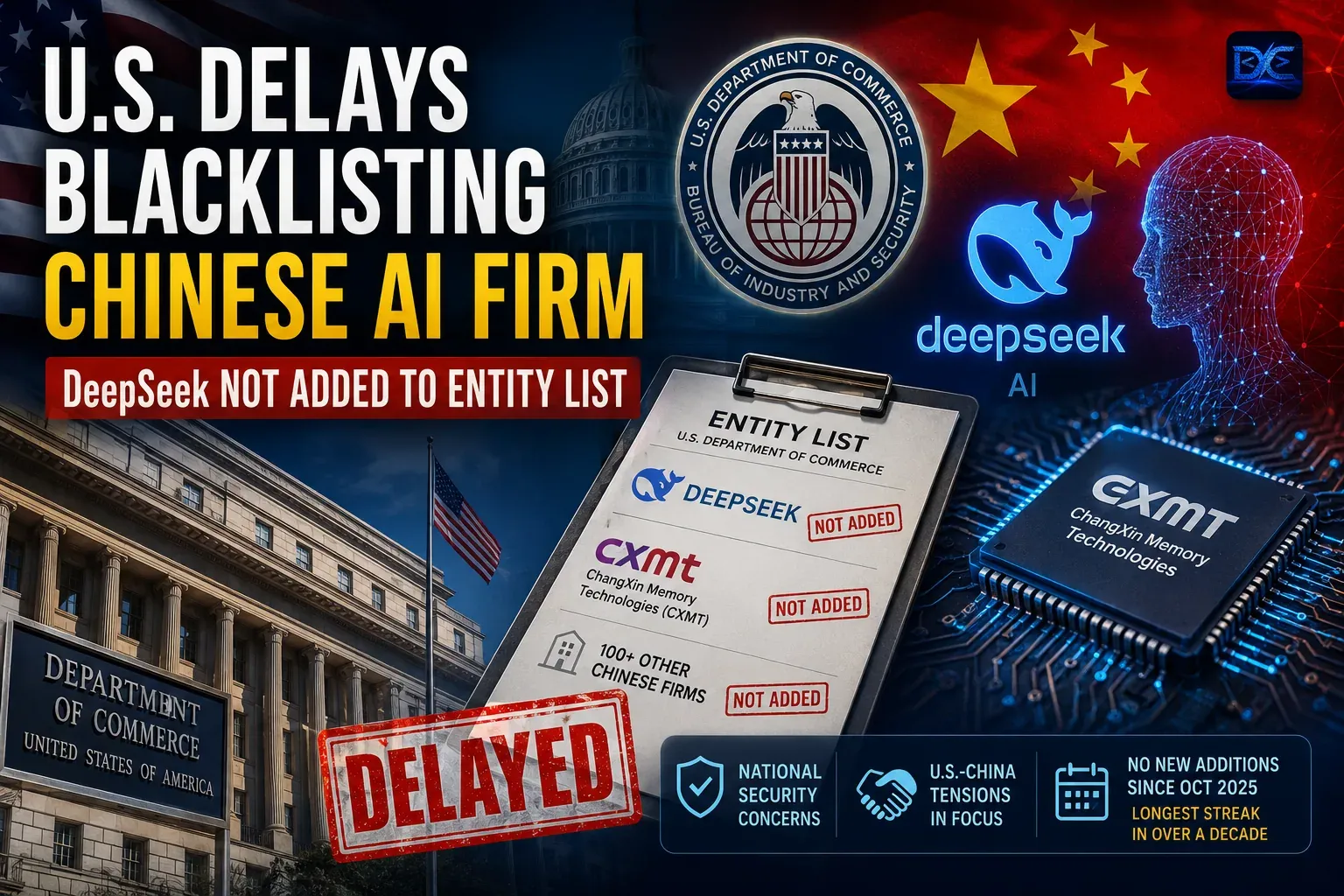
U.S. Holds Off on Blacklisting DeepSeek: What the Delay Really Means
An internal U.S. panel approved adding Chinese AI startup DeepSeek (and chipmaker CXMT and 100+ others) to the Commerce Entity List — but the listings haven't been published. Here's a plain-English explainer of the Entity List, why the delay happened, and what it changes.
Have a project or an idea?
We don't just write about software — we build it. Tell us what you're working on and we'll get back within 1–2 business days.